Marathon FL SEO Services: A Primer
If you run a business in Marathon, your SEO problem is not the SEO problem that a national agency will pitch you. The national version is about keyword research, content velocity, link building, technical audits. The Marathon version is about three things, in this order: your Google Business Profile, the geo modifier in your H1, and whether your site loads on a phone in the truck on US-1. Most of what is sold as “SEO services” for small businesses is the wrong work for the Keys market. The right work is unsexy, mostly mechanical, and produces measurable Local Pack movement inside six weeks if done with discipline.
The local-pack reality
For most of what Marathon businesses sell — charters, food, lodging, dive trips, real estate, retail — the search experience that closes a customer is the Local Pack. The three boxes Google shows under the map. If you are not in the top three for a query a tourist runs sitting in their rental car at the Vaca Cut bridge, the work below the map probably does not matter for that booking.
The thing that puts you in the top three is, mostly: a fully claimed and optimized Google Business Profile, a consistent NAP (name, address, phone) across every listing of you on the web, photo uploads on a steady cadence, and reviews coming in regularly. Anchor links and on-page SEO matter, but they are second-order factors next to the GBP work. A Marathon restaurant with 280 reviews averaging 4.3 stars and three new reviews per week will out-rank a Marathon restaurant with 800 reviews averaging 4.6 but no new ones in six months. Velocity beats stock.
The Marathon-specific factor is that the competition is small — usually three to ten serious operators per category — and most of them have not done the work. That means a disciplined six-week push on the GBP, the schema, and the on-page SEO is enough to move the pack in a way that would take six months in a Miami suburb. The work is not harder; it is just rarer.
The 8-second test for your homepage
When a Marathon visitor lands on your site from a search, they decide within eight seconds whether to call you. Five things they look for, and what each one actually looks like done right:
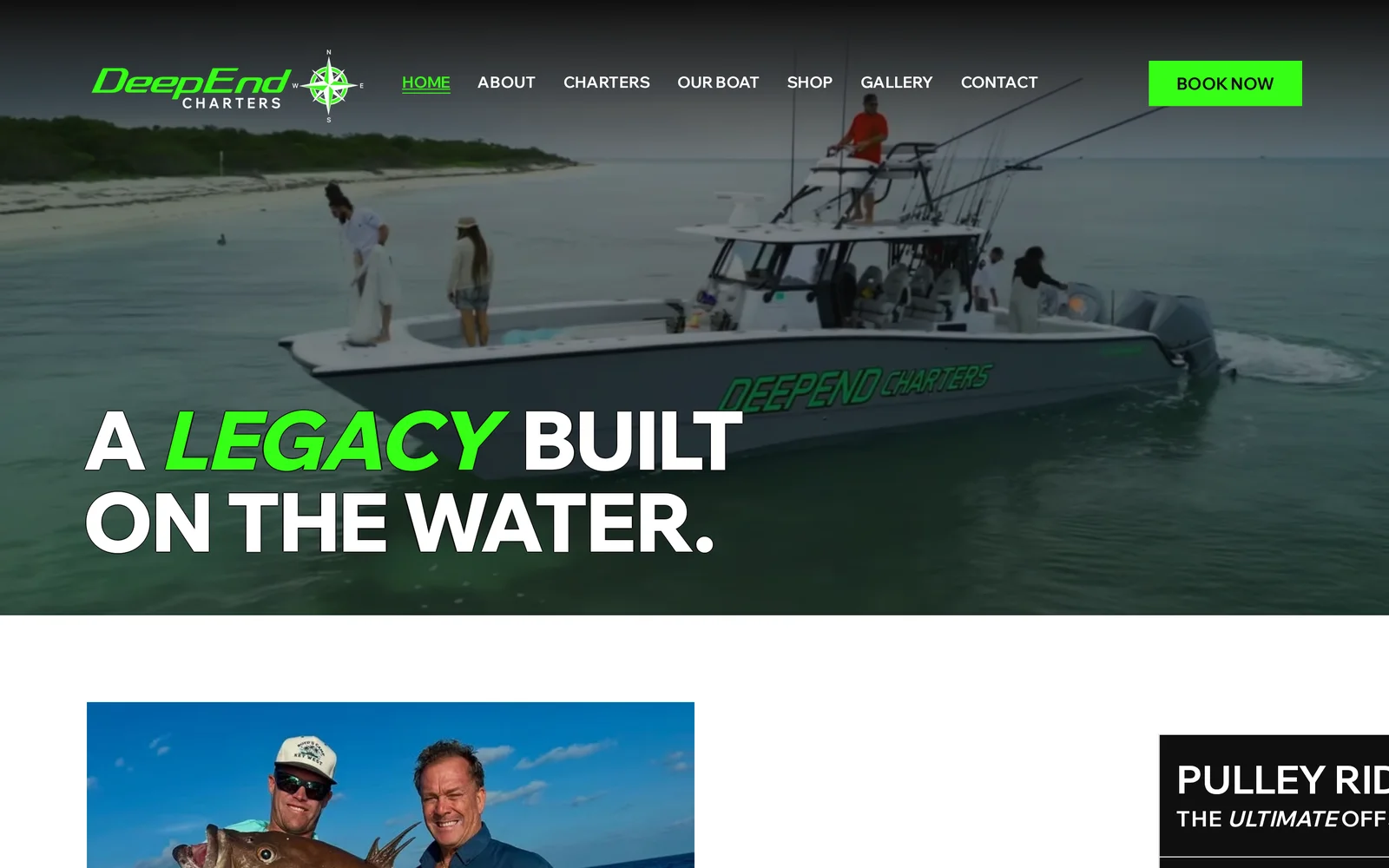
A real photo of the business — not a stock palm tree. This is the single biggest conversion factor and the single most-skipped one. A photo of your actual boat at your actual dock, your actual restaurant interior at your actual lunch service, your actual storefront on US-1 — even shot on an iPhone — out-performs the best stock library in the world. The brain registers stock as generic Florida within half a second and discards it. Original photography of the property is the work most Marathon sites we audit have not done.
A clickable phone number visible above the fold. On mobile, this should be a tel: link so a tap dials the call. The number should be styled like a button or a clearly-visible link, not buried in the header in 12-point gray. About 30 percent of mobile-first Keys conversions are phone calls — making the number scannable in the first eight seconds is the highest-ROI single design choice you can make.
The word “Marathon” or “Florida Keys” in the first sentence. This is the geo modifier and it does three jobs: it tells the visitor they are in the right place, it tells Google’s algorithm the page is locally relevant, and it tells AI search engines (ChatGPT, Perplexity, Google AI Overviews) that the page is a candidate for queries about Marathon or the Keys. A page that says “We are a charter operation” does none of these jobs; “Marathon’s offshore charter operation” does all three.
Some idea of what it costs. A starting price, a price range, or a clear “request a quote” button. Sites that hide pricing behind a contact form lose conversions to sites that show a number, even an approximate one. For Keys businesses where the trip type or service is well-defined (a half-day charter, a dinner menu range, a typical dive package), publishing a starting price is almost always the right call.
One clear next step — call, book, message. The above-fold area should have exactly one primary call to action. Two or three options compete with each other and reduce conversion on the primary one. The visitor decides in eight seconds; the page should tell them the one thing to do next, with a button that looks like a button.
What we run for Marathon clients
Real local SEO work for a Marathon business looks like this. Week one is a Google Business Profile audit and optimization: correct primary category, secondary categories, populated service menu, refreshed photo library, posted hours, and a verified service area. Week two is a geo-modifier rewrite of every priority page on the site — homepage H1, service-page H1s, location-page H1s, page titles, meta descriptions. Week three is LocalBusiness and Service schema markup, with areaServed set to Marathon and the relevant surrounding towns. Week four is the start of a steady photo and post cadence on the GBP — one to two posts per week, photo uploads at least monthly, and a process for asking for reviews after every closed engagement.
From month two onward the work is maintenance plus growth: rank tracking, GBP post cadence, review velocity, internal linking improvements, and a small monthly investment in long-tail informational content (a blog post or two per month on topics actual Marathon customers search for). Reporting is a one-screen monthly dashboard — spend, rankings, GBP impressions, organic traffic, conversions — not a 47-page PDF nobody reads.
What does not work in Marathon
A few things that get sold to Keys businesses as SEO services and are usually waste:
Link-building campaigns from generic publications. A backlink from a random business-listing site in Pakistan is not the same as a link from a Florida Keys publication and Google knows the difference. Most paid link-building services we audit have either done nothing measurable or have created a toxic profile that has to be disavowed.
Content velocity for its own sake. Publishing four blog posts a month does nothing if none of them target a Marathon-specific query. Two well-targeted posts a month, written for actual buyer searches and structured for AI Overview citation, beats four generic posts every time.
SEO without GBP work. A vendor that takes $1,500/month for “SEO” without touching your Google Business Profile is leaving the Local Pack on the table. For Marathon businesses, GBP is usually 60 percent of the win. Any engagement that ignores it is mispriced.
Talk to OMG about Marathon SEO
OMG is based in Marathon and runs SEO for clients across the Middle Keys footprint. We publish the full SEO service scope and a Marathon-specific service page with FAQs about how we work here. For a one-time SEO audit or an ongoing engagement, start a conversation — a 20-minute call, a written scope inside a week.